How to Light a Jigsaw Puzzle Table After Dark
Brand contribution from Dazuma.
By four o’clock, the little red cabin has a roof, the boat has a sail, and somebody has sorted the lake pieces from the sky. After supper, those two piles look suspiciously alike. Worse, there’s a white patch in the middle of the lake that slides across the picture whenever you move your head. You could call it a night. Or you could spend five minutes finding out what the light is doing to your puzzle.
Start with whoever has the worst seat. If everyone keeps drifting around to Grandma’s side of the table, sit where she sits and then take the chair opposite. The lamp hasn’t changed. What you can see may have changed quite a bit.
Try the shiny piece first
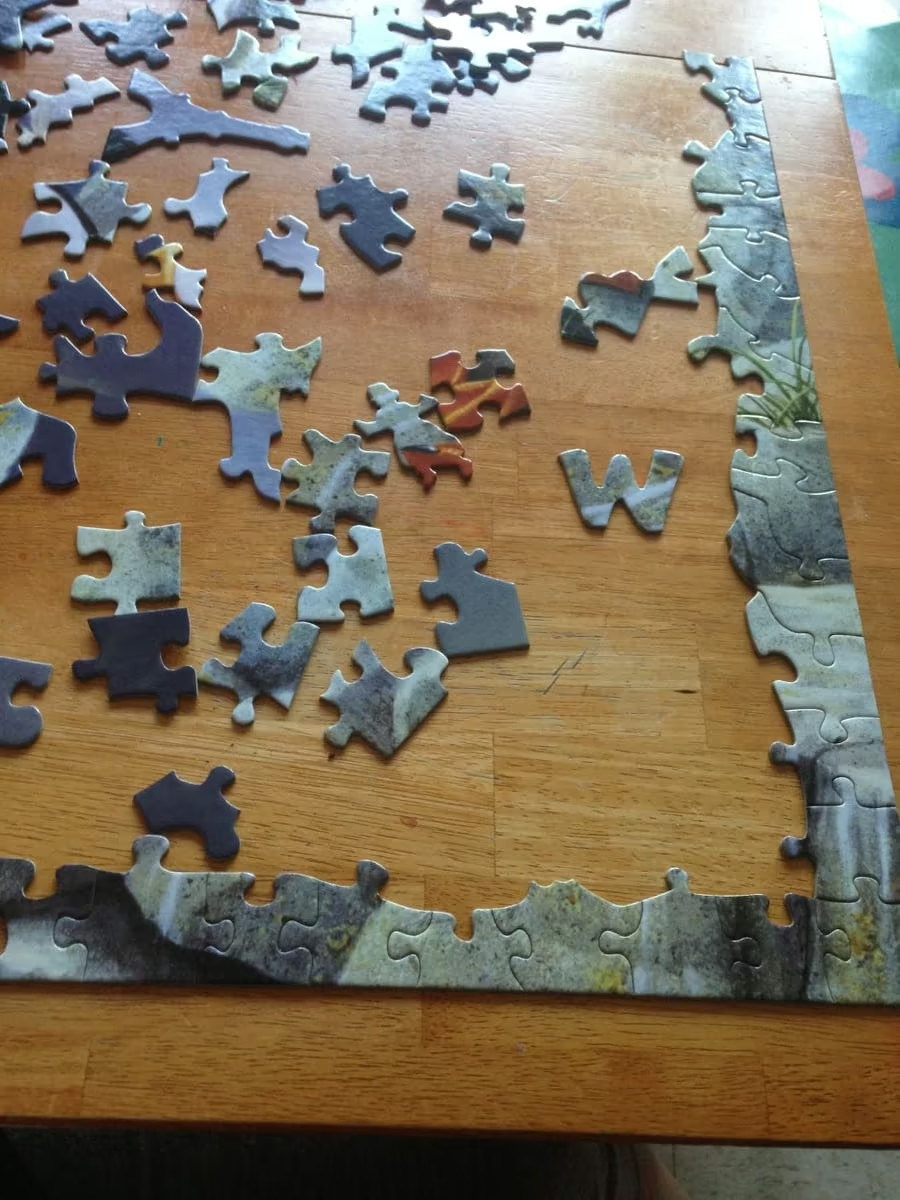
Pick a glossy piece with some dark printing on it. Set it flat near the center of the puzzle, where a piece has to end up even if you sort everything at the edges. Look at it from your usual chair. Now tip one edge up slightly. If the tree branches suddenly appear where you were seeing a white streak, you’ve found a reflection. More light from the same spot is unlikely to help. The useful change is the angle between the light, the piece and your eyes.
You don’t have to move a ceiling fixture to try a different angle. If you work on a puzzle board, slide the board a few inches toward one end of the table. Or switch off the overhead and borrow a shaded lamp from the living room. Set it on a stable surface to one side, where its cord won’t cross the walkway. Take both seats again. If the white streak disappears but the far half is too dim to use, you may want both lights on, with the overhead turned down if it’s dimmable.
Look at the underside of the pendant
If you’re shopping for modern pendant lights, the side view only tells half the story. Find a photo taken from below. Can you see a bare bulb, a narrow glowing strip or a broad glowing surface? A diffuser can soften the sharp reflection of a bare bulb, though a glossy puzzle may still show a pale reflection of the diffuser itself. It helps to know which shape you’ll be looking for.
The black housing is wide, but the part that lights up is a narrow strip. On shiny cardboard, a reflection of that strip can look like a pale line.
Then put your hand back where it belongs: on the puzzle. Hold a piece over the spot you think it fits. If your fingers put the two adjoining tabs in shadow, move the side lamp across the table and try once more. For one person, a lamp on the side opposite the working hand is a useful starting point. With two people facing each other, let the second person try it before you declare victory. There’s no great family achievement in transferring your shadow to your sister.
Measure the puzzle spread, including the lid
A thousand-piece puzzle uses more table than the dimensions on the box would have you believe. There’s the picture itself, the box lid propped up for reference and the tray of pieces that might be chimney, fence or the dog. Set them all out before deciding where the light belongs. An easy check is to carry the same dark piece from the middle of the board to each sorting tray. When does the printing get hard to see?
For a rectangular table that stays put, a long fixture with several light sources can put light over more than one work area. When comparing pendant lighting, check where those sources are along the fixture. A decorative bar can be quite long even when its lights are close together. There’s also a perfectly good low-cost solution: swap the well-lit bowl of pretzels for the tray of dark pieces. Nobody needs fine detail to find a pretzel.
Four separate globes span this table. Picture where your sorting trays would sit in relation to them, not just where the table center falls.
Keep a pair of almost-matching pieces
Save one lake piece and one sky piece that you can reliably tell apart by the window. They make better samples for your own table than a photograph of somebody else’s dining room. Lay them on a plain sheet of paper after dark. Try your usual setting, then change just one thing: the dimmer level, the fixture’s color setting if it has one, or the side lamp. Give each setting a moment before deciding. The one that looks brightest on the white paper might not be the one that lets you see the faint ripple on the lake.
Keep the box lid in the test, too. Its glossy picture often sits upright while the pieces lie flat, so a lamp position that works for one can put a bright blob right over the cabin on the other. Turn the lid a little or prop it at a gentler slope. A folded dish towel tucked under its bottom edge keeps it from skidding back down.
If your puzzle lives on a folding table, give yourself permission to leave the ceiling alone. A chair turned a quarter turn or a lamp you bring out with the puzzle may do the job. That’s particularly handy when the table goes back in the closet on Sunday. The test is whether everyone can settle into a seat and pick up where they left off after supper. If the lake is blue again and nobody has to surrender Grandma’s chair, the lighting is doing its share.


2 Comments
Terri Quick
Great idea
heather
This was a fun post to read. I haven’t done a puzzle in ages and they are so fun and relaxing.